
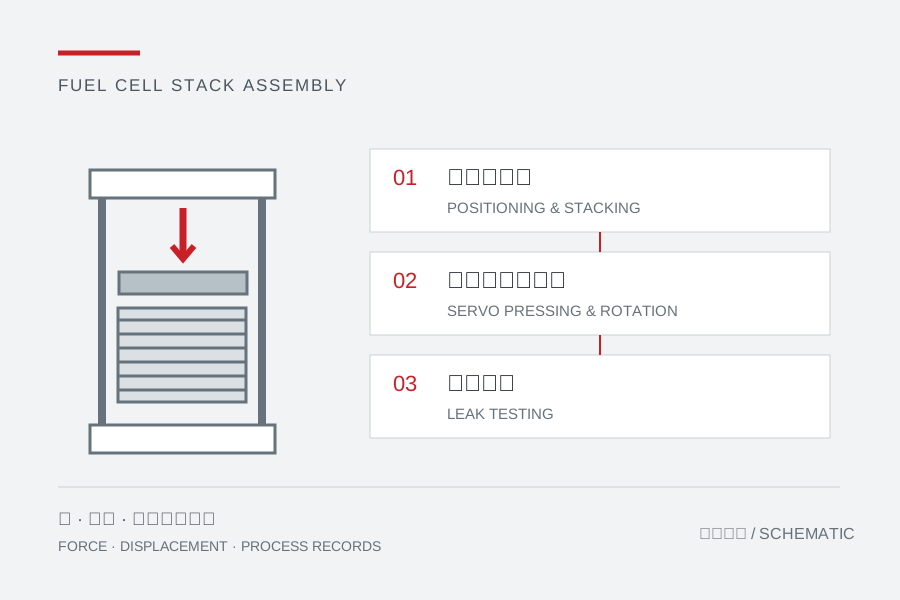
Hydrogen fuel-cell stack assembly equipment
Positioning, servo pressing, rotation and leak testing, with force and displacement records during stack assembly.
Positioning fixtures and frame
Dedicated fixtures support fuel-cell stack assembly. Body rotation and gravity assist alignment of bipolar plates and membrane electrode assemblies, reducing repeated positioning adjustments. Fixtures are configured for stack geometry, plate dimensions and assembly requirements.
A three-beam, four-column frame with precision linear bearings supports and guides the pressing and positioning mechanisms. Structure, fixture interfaces and assembly space are checked for the stack specification and adjacent operations.
Servo pressing and rotation control
Servo-electric cylinders drive pressing and rotation. They control pressing force and displacement and allow fine adjustment of the rotation angle. Process settings coordinate pressing, positioning and inspection in the defined sequence.
Manual and automatic modes are available, and pressing, rotation and leak-test modules can operate independently. Automation of loading, stacking and unloading depends on the overall line configuration and the allocation of operator and machine tasks.
Leak testing and test interfaces
Online preliminary leak testing can be configured during the pressing hold stage, with separate checks of the hydrogen-side, air or oxidant-side and coolant circuits. Separate circuit checks help identify larger leaks before subsequent strapping or assembly.
Test media and interfaces are matched to the stack. For compressed-air testing, the medium, pressure and leakage limits must be confirmed against stack requirements. Positioning fixtures and an upper test module provide interfaces to the corresponding test system.
Process data and equipment integration
A PLC and touchscreen provide machine control and operator interaction. Pressure and displacement sensors acquire pressing data in real time. Force, displacement and associated records can be stored for traceability, process analysis and parameter adjustment.
Protection against overload, overcurrent, overheating and travel limits can be selected for the actuators and site conditions, together with maintenance access, module adjustment and upstream or downstream interfaces. Stack specifications, pressing requirements, tests and planned cycle time determine the final configuration.
Equipment photographs
Equipment selection and line enquiries
Share your battery type, processing goals and site conditions so we can assess the process.